

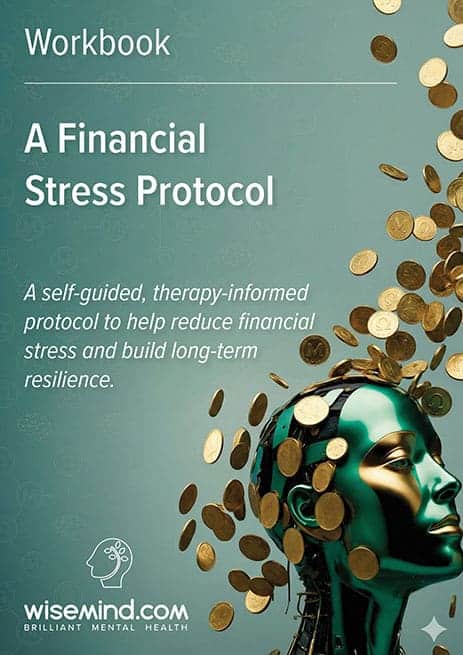
A Financial Stress Protocol
Mind Over Money — from Reactive to Resilient
A self‑guided, therapy‑informed protocol designed to help you understand your financial stress patterns, help calm your nervous system, and build resilient money habits over time.
Listen to a preview session
Hear a short preview of audio lesson 1 to see how the pathway works before you join.
If you’ve been feeling overwhelmed, paralyzed, and stuck in chronic worry loops about money for weeks or months, you’re not alone. Many adults quietly carry intense financial stress layered on top of everyday pressure—a burden driven not by a lack of intelligence, but by a survival system treating a bank statement like a physical predator. This protocol is built for those moments when an amygdala hijack leaves you trapped in cycles of avoidance, shame, or reactivity, offering a gentle, therapy-informed pathway to face financial reality and reclaim your baseline security.
What this financial stress pathway offers
Designed to bridge the gap between financial literacy and the powerful neurological and emotional drivers of money-related behavior. Rather than focusing on traditional accounting, the curriculum explores the neuroscience of financial stress, explaining how the “amygdala hijack” can cause even intelligent individuals to make reactive or avoidant decisions during economic uncertainty. Students are guided through an exploration of their own “money stories”—the inherited scripts and childhood imprinting that shape their current financial habits—while learning to use Cognitive Behavioral Therapy (CBT) tools and physiological regulation to interrupt chronic anxiety loops.
This content is only available to wisemind.com members.

SESSIONS IN THIS PROTOCOL
011
Start Here: Discover Your Money Story
Rewire your relationship with money—from reactive to resilient. Before beginning the clinical lessons, you must first uncover the unconscious "emotional architecture" driving your financial decisions. Start your journey by taking the Discover Your Money Story diagnostic survey to identify your primary money narrative—Avoider, Worshipper, Status, or Vigilant. By establishing this personal baseline, you will move...
01
Lesson 01: Why Smart People Make Terrible Money Decisions
Financial stress isn't a personal failure; it's a "amygdala hijack." Our brains treat market drops like physical predators, bypassing rational thought for survival instincts. By identifying fear-driven patterns and using "interruption strategies" like breathwork, you can downregulate this ancient stress response and restore the analytical power needed for smart decisions.
06
Meditation 01: Settling Your Nervous System Around Money
This 15-minute somatic meditation serves as "financial first aid" for acute stress. By utilizing extended exhales and vagus nerve stimulation, it down-regulates the nervous system during market volatility or unexpected bills. Shift from survival-based reactivity to regulated awareness, grounding your body to approach financial tasks with a clear, calm prefrontal cortex.
02
Lesson 02: Where Your Beliefs Come From
Your financial habits are often "emotional architecture" built in childhood. Long before learning to budget, your brain encodes parental attitudes as implicit memories of safety or scarcity. By uncovering unconscious "Money Scripts" and intergenerational trauma, you can update these hidden narratives with compassion, aligning your present-day behavior with your true values.
07
Meditation 02: Letting Go of Financial Shame
This meditation utilizes Compassion-Focused Therapy to dismantle financial shame. By decoupling your self-worth from your bank balance, you’ll practice self-touch to trigger oxytocin and shift from "I am a failure" to "I made a mistake." Reclaim your financial agency by replacing avoidance with mindfulness and radical, supportive self-kindness.
010
My Money Story: A Guided Journaling Template
Your financial habits are often "emotional architecture" built in childhood. Long before learning to budget, your brain encodes parental attitudes as implicit memories of safety or scarcity. By uncovering unconscious "Money Scripts" and intergenerational trauma, you can update these hidden narratives with compassion, aligning your present-day behavior with your true values.
03
Lesson 03: Breaking the Anxiety Loop
Lesson 3 transforms understanding into action by applying Cognitive Behavioral Therapy (CBT) to financial anxiety. It dismantles the "anxiety loop"—where triggers spark catastrophic thoughts and avoidant behaviors—using "Thought Records" to test fears against reality. By identifying cognitive distortions and utilizing "Worry Windows," you regain control over financial stress.
09
Meditation 03: Your Money Story
Trace the "upstream" sources of your financial beliefs through this guided visualization. By identifying inherited "Money Scripts" and childhood narratives, you can decouple past survival strategies from your current reality. Meet your younger self with compassion to release intergenerational weight and step into the clarity of conscious, adult financial choice.
04
Lesson 04: Resilience vs Resistance — Living Well in Uncertain Times
Lesson 4 redefines "genuine resilience" as the capacity to adapt after disruption, rather than just resisting it. Utilizing Post-Traumatic Growth and Acceptance and Commitment Therapy (ACT), the module emphasizes adaptive coping—approaching reality rather than avoiding it. It teaches that while financial pain is inevitable, suffering through resistance is optional.
08
Meditation 04: Clarity in Uncertainty
Navigate sustained economic uncertainty by shifting from resistance to equanimity. This ACT-based practice helps you distinguish global noise from personal agency using the "Circle of Control" visualization. Instead of bracing against the unknown, cultivate an alert presence to identify values-consistent actions, reclaiming clarity and purpose amidst shifting market conditions.
05
Lesson 05: From Surviving to Thriving
The final lesson deconstructs the "arrival fallacy," proving that financial security isn't a fixed destination. It explains the "Hedonic Treadmill," where the nervous system adapts to wealth while maintaining old anxieties. By defining "Enough" through personal values and "portable security," you gain internal stability regardless of external market fluctuations.
DEEPENING THE WORK: CLINICAL BOOK REVIEWS
While the structured sessions of the Financial Stress Protocol provide the framework for your shift, these audio book reviews offer critical perspective on the intersection of psychology and finance. These are optional companion insights provided to support your integration of these concepts. Listen to them at your own pace as they resonate with your personal money story.






OTHER THERAPY PATHWAY MODULES


Join wisemind.com
What Is Included in My Membership?

- Therapy Pathways
- Clinical Book Reviews
- Guided Meditations
- Advanced Online Learning
- 600+ Online Masterclasses
- 600+ Quizzes
- CPD/CE/CME Certificates
- Workbooks
- Therapy Pathways
- Clinical Book Reviews
- Guided Meditations
- Advanced Online Learning
- 600+ Online Masterclasses
- 600+ Quizzes
- CPD/CE/CME Certificates
- Workbooks